
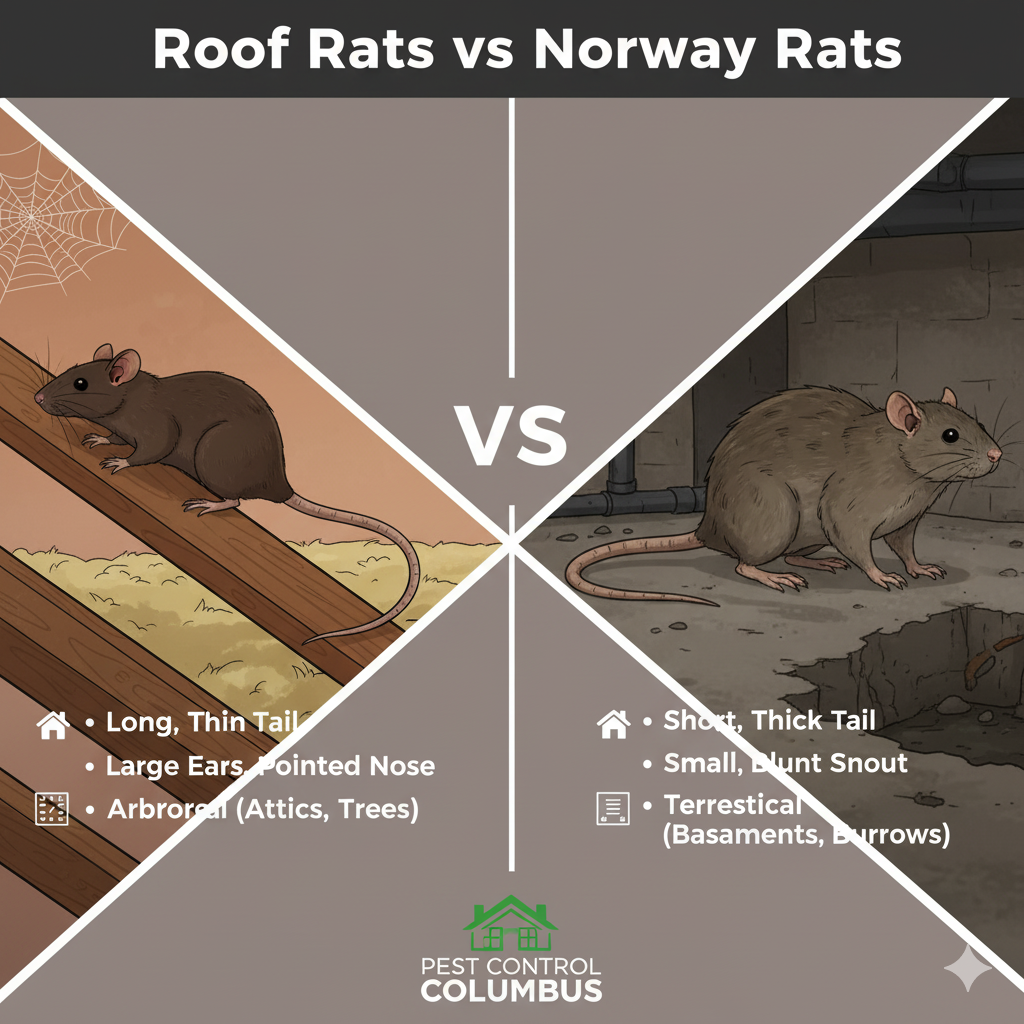
Rodents are one of the most common pest problems faced by homeowners across the country. They can cause structural damage, contaminate food, and spread dangerous diseases. Two of the most widespread rat species in the United States are the Norway rat and the roof rat. While many people assume all rats are the same, these two species are quite different in their appearance, habits, and preferred habitats. Recognising the differences can help you determine the type of infestation you are dealing with and the best strategy for eliminating it.
At Pest Control Columbus, we regularly assist homeowners in identifying and controlling rodent problems. Whether it is a Norway rat digging tunnels near the foundation or a roof rat nesting in the attic, knowing which species you are up against is the first step in developing an effective plan for removal and prevention.
Understanding Norway Rats
Norway rats, also known as brown rats, sewer rats, or common rats, are larger and stockier than roof rats. Their bodies are plump with grayish-brown fur, a blunt nose, and small eyes and ears. They can reach body lengths of up to 10 inches, and their tails are shorter and thicker than their bodies, usually covered with fine scales.
Norway rats prefer to live at ground level. They are skilled diggers and often build burrows in basements, gardens, and areas around foundations. They are also commonly found near sewer systems, which is why they are sometimes referred to as sewer rats. Their droppings are blunt at the ends and typically measure about three-quarters of an inch in length, making them easy to identify.
This species is more prevalent in colder climates and urban environments. In northern states and cities, Norway rats often outcompete roof rats for resources and territory, which makes them the dominant rat species in many areas.
Signs of Norway Rats in Your Home
- Burrows or tunnels near the foundation or in the garden.
- Grease marks or rub marks along walls from their oily fur.
- Large, blunt-ended droppings.
- Gnaw marks on wood, wires, or food packaging.
- Noises in walls or basements, especially at night.
Understanding Roof Rats
Roof rats, also called black rats or ship rats, are more slender and agile than Norway rats. Their fur is darker, often black or dark grey, with a lighter underbelly. They have long, thin tails that are longer than the combined length of their head and body. Their noses are pointed, and their ears are larger and more prominent than those of Norway rats.
As excellent climbers, roof rats prefer elevated nesting sites. They often build nests in attics, false ceilings, dense vegetation, and trees. This climbing ability gives them access to food and shelter in areas that Norway rats cannot easily reach. Their droppings are smaller, pointed at the ends, and measure about half an inch long.
Roof rats thrive in warmer, temperate regions, which makes them more common in southern states. They are less frequently found in colder climates, where Norway rats usually dominate.
Signs of Roof Rats in Your Home
- Nests in attics, ceilings, or trees near the home.
- Long, thin droppings with pointed ends.
- Scratching or scurrying noises above ceilings at night.
- Gnaw marks on food containers and wires.
- Sightings of slender, dark-colored rats climbing or moving along power lines, rafters, or tree branches.
Key Differences Between Norway Rats and Roof Rats
While both species pose serious problems for homeowners, understanding their differences helps in identifying and controlling infestations more effectively.
Appearance:
- Norway rats are stockier with gray-brown fur and blunt noses.
- Roof rats are slimmer, darker, and have pointed noses.
Size:
- Norway rats can grow up to 10 inches in body length.
- Roof rats are smaller, averaging around 8 inches.
Tail:
- Norway rats have shorter, thicker tails than their bodies.
- Roof rats have long, thin tails that are longer than their head and body combined.
Habitat:
- Norway rats prefer ground-level areas and burrows.
- Roof rats prefer elevated areas such as attics, trees, and rafters.
Droppings:
- Norway rat droppings are large and blunt-ended.
- Roof rat droppings are smaller and pointed at the ends.
Climate Preference:
- Norway rats are more common in colder, urban regions.
- Roof rats are more common in warmer, temperate regions.
Health Risks Associated With Both Species
Both Norway rats and roof rats can spread serious diseases. They are known carriers of Salmonella, leptospirosis, rat-bite fever, and hantavirus. Their droppings and urine can contaminate food and surfaces, creating dangerous health hazards for humans and pets. Additionally, their gnawing behaviour can damage electrical wiring, creating fire risks, and weaken structures by chewing through wood, insulation, and even plastic.
How to Identify Which Rat You Have
Determining whether you have Norway rats or roof rats is crucial for effective control. Because their habits are so different, the treatment and prevention strategies will also differ. For example, traps placed on the ground may be effective against Norway rats, while traps set in elevated locations are necessary for roof rats.
Inspecting droppings, looking at nesting sites, and observing their activity can provide clues. A professional pest control technician can confirm the species and create a customised treatment plan.
Control and Prevention Strategies
Both Norway rats and roof rats require a combination of strategies to control and prevent infestations.
Exclusion
- Seal gaps, cracks, and holes in foundations, walls, and roofs.
- Install screens on vents and windows.
- Close gaps around pipes and utility lines.
Sanitation
- Store food in sealed containers.
- Keep trash in rodent-proof bins.
- Clean up crumbs, spills, and pet food promptly.
Habitat Modification
- Trim trees and shrubs away from the house.
- Remove clutter, firewood piles, and debris that provide shelter.
- Reduce standing water around the property.
Trapping and Baiting
- Use snap traps or bait stations placed strategically in areas of activity.
- For Norway rats, focus traps on ground-level locations.
- For roof rats, place traps in attics, rafters, and elevated spaces.
Because rats are intelligent and cautious, it often takes professional expertise to effectively eliminate them.
Why Professional Help is Essential
DIY solutions may provide temporary relief, but rodent infestations often require professional attention. Norway rats and roof rats breed quickly, and a small problem can turn into a major infestation in a short time. Professionals have the tools, knowledge, and experience to correctly identify the species, locate nesting sites, and apply safe and effective treatments.
Working with a trusted provider like Pest Control Columbus ensures that your home receives tailored solutions for long-term rodent control. Professionals also provide follow-up services, sealing entry points and offering prevention strategies to stop infestations from returning.
Conclusion
Norway rats and roof rats may both be unwelcome intruders, but they are not the same. Norway rats are larger, stockier rodents that burrow at ground level, while roof rats are smaller, slender climbers that prefer elevated nesting sites. Their droppings, size, and habits also differ, which makes accurate identification essential for effective control.
Both species pose serious health and property risks, making it important to act quickly if you notice signs of an infestation. By combining exclusion, sanitation, and professional pest control services, homeowners in Columbus can protect their homes and families from the dangers posed by these rodents.
Understanding the differences between Norway rats and roof rats is the first step toward creating a pest-free environment. With the right approach, you can keep these destructive pests out of your home and maintain a safe, comfortable living space.
FAQs – Roof Rats vs Norway Rats
- What is the difference between a Norway rat and a roof rat?
Norway rats are larger, stockier rodents that live at ground level and prefer burrows, while roof rats are slimmer, excellent climbers that nest in attics, trees, and rafters. - How can I tell if I have Norway rats or roof rats in my home?
Check droppings, nesting sites, and activity patterns. Norway rat droppings are blunt-ended and larger, while roof rat droppings are smaller and pointed. Roof rats are often found in attics, whereas Norway rats are found in basements or near foundations. - Which type of rat is more common in Columbus, Ohio?
Norway rats are more common in colder climates and urban areas like Columbus, while roof rats are usually found in warmer, southern states. - Do roof rats and Norway rats cause the same problems?
Yes. Both species spread dangerous diseases, contaminate food, damage property, and chew electrical wires, which can create fire hazards. - Where do Norway rats usually nest?
Norway rats prefer to burrow in soil near foundations, gardens, basements, and sewer systems.